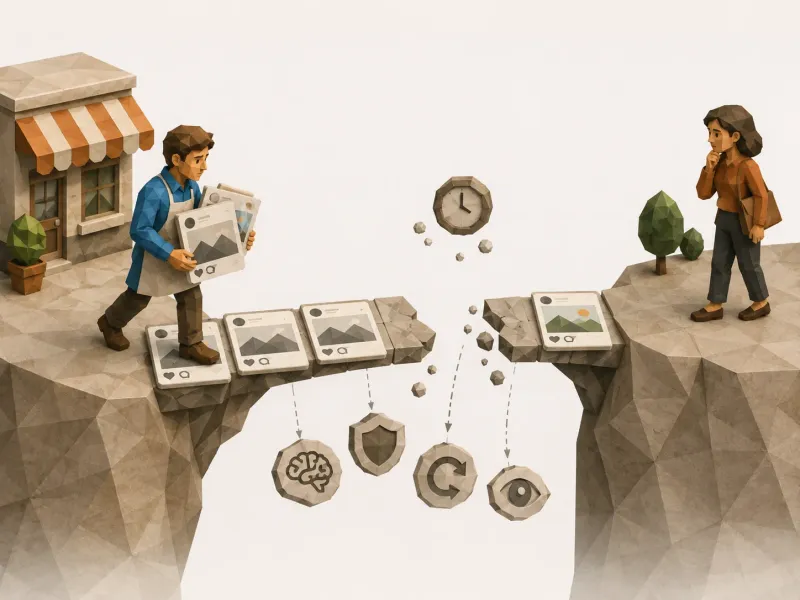

Inconsistent Instagram posting creates more than a reach problem. It makes people re-learn your business, weakens trust signals, and turns every return into a restart.
Going quiet on Instagram does not send an invoice.
That is part of why the cost is easy to ignore.
You miss a week because the business gets busy. Then another week passes. Nothing dramatic happens. No warning appears. You simply lose a few chances to be remembered, a few chances to answer a question, and a little of the context that helps a new visitor understand why they should choose you.
Then, when you return, the work feels larger than it did before the gap.
That is the inconsistency tax: the extra effort created by disappearing and having to rebuild familiarity, confidence, and momentum instead of maintaining a small presence.
The expensive part of inconsistency is not the missed post. It is the repeated cost of starting from less context than you had before.
The four parts of the tax
1. The memory cost
People rarely decide to contact a local business the first time they see it. They notice you, keep scrolling, remember the name later, and return when the need becomes relevant.
A quiet account removes some of those reminders. It does not mean everyone forgets you immediately. It means fewer small opportunities exist for the business to stay available in their memory.
This matters most when the purchase is occasional: a haircut, a class, a custom piece, a treatment, a celebration order, or a service someone is still considering.
2. The trust cost
A current profile gives a potential customer evidence that the business is active. Recent work, current availability, and ordinary signs of life make the account easier to trust.
A long gap leaves the visitor to guess. Is the business still open? Are these services still available? Is the information current? Has the quality changed?
They may never ask. They may simply choose the account that looks easier to understand today.
3. The restart cost
Returning after a gap often feels like returning to a new account. You have to decide what to say, explain the absence, rebuild a rhythm, and resist the urge to make the comeback impressive.
That is more work than continuing with one ordinary post at a time.
The Instagram guilt loop describes the emotional version of this pattern. The inconsistency tax is the operational version: every restart asks you to recreate decisions that a small system could have preserved.
4. The attention cost
When you disappear, the next post has to reintroduce the business to people who may have seen you before. The content may be good, but it has less recent context around it.
A small rhythm gives each post somewhere to land. A burst after a long silence has to do more work by itself.
This is not an argument for posting every day
Daily posting is not the opposite of silence. It is one possible way to avoid long gaps, and for many small business owners it creates a new failure point.
A plan that requires seven fresh decisions a week can produce a predictable cycle: publish frequently during a motivated week, run out of energy, disappear, feel guilty, then try to restart at the same high frequency.
The better target is a rhythm with enough space around it to survive a busy week. Three useful posts can be enough. Two can be enough during a difficult month. The number matters less than whether the system gives you a realistic way back when life interrupts it.
What the tax looks like in practice
Imagine a massage therapist who posts for three weeks, then disappears for a month. When she returns, she needs to:
- remind people what sessions she offers
- make the room and experience feel current
- explain how to book
- rebuild the habit of noticing useful moments
- decide whether the first post should be educational, personal, or promotional
- manage the discomfort of publishing after the gap
None of those tasks is enormous. Together, they create enough friction to make the next post easier to postpone.
If she had continued with one room detail, one first-visit answer, and one availability note each week, she would not have needed a comeback campaign. The profile would have kept carrying some of the explanation.
| Small weekly rhythm | After a long gap |
|---|---|
| Share one current business detail | Find a strong enough detail to justify returning |
| Answer questions as they appear | Re-establish what the business offers |
| Mention availability naturally | Make the first post carry the booking message |
| Review patterns over time | Wonder whether one return post worked |
| Continue from existing context | Recreate the plan and confidence from scratch |
The manual fix is usually too large
When people notice they have gone quiet, the first response is often a large recovery plan: write a month of content, batch everything, redesign the profile, and post every day until the account looks active again.
That plan feels responsible. It also increases the size of the first step.
The batch-and-schedule review explains why large protected sessions often fail for solo operators: the business keeps reclaiming the time. A recovery plan with the same shape is likely to fail for the same reason.
The better fix is smaller:
- Publish one current, ordinary post.
- Choose a frequency that fits the next two weeks.
- Keep a short list of real moments from the business.
- Use a draft starting point when the blank screen appears.
- Review the rhythm after it has had time to work.
You are restoring continuity, not paying off a moral debt.
What lowers the inconsistency tax
The tax gets smaller when the cost of the next post gets smaller.
That means keeping a few decisions outside the moment of publishing:
- a simple list of topics your customers care about
- a clear description of how the business sounds
- a realistic posting frequency
- a way to turn one real moment into several possible angles
- a rule for returning after a missed week
The Posting Planner helps with the frequency decision. The Post Idea Generator helps when the business has material but no obvious angle. The Brand Voice Finder helps preserve the language that makes the account recognisable.
The Calm Visibility Routine puts those decisions into a small weekly pattern: choose three real things, create three small posts, and review without obsessing.
The practical default
Pick the lowest frequency that keeps the account current and leaves enough energy to continue. For many businesses, that is three posts a week. For others, it may be two.
When you miss a week, do not add a penalty. Return with the next real detail, publish it, and continue at the same pace.
The goal is not a perfect record. It is reducing the number of times the business has to reintroduce itself from scratch.
Questions about inconsistent Instagram posting
What is the inconsistency tax on Instagram?
It is the extra effort created by going silent and having to rebuild familiarity, trust signals, business context, and a posting habit after the gap. The cost is not a literal penalty. It is the work that would have been smaller if the account had maintained a modest rhythm.
Does Instagram punish inconsistent posting?
Reach can change when an account becomes less active, but the more practical cost is often the experience of the person visiting the profile. A long gap can make the business look less current and forces the next post to carry more of the explanation. The account is recoverable; rebuilding is simply more work than maintaining.
How often should a small business post on Instagram?
Start with the lowest frequency you can maintain when the business is busy. Three useful posts a week is a reasonable default, but two may be better if three repeatedly causes the routine to collapse. A sustainable rhythm is more valuable than a high target followed by silence.
What should I do after not posting on Instagram for a month?
Do not announce the return or create a large catch-up plan. Share one current, ordinary detail about the business, then choose a realistic rhythm for the next two weeks. The aim is to restore continuity, not make the gap the centre of the account.
How do I stay consistent when my business is unpredictable?
Use a small routine with flexible material. Keep a list of real moments, choose a modest frequency, and make the next post from whatever is current rather than planning every detail weeks ahead. Short creation windows are often more resilient than one large content block.