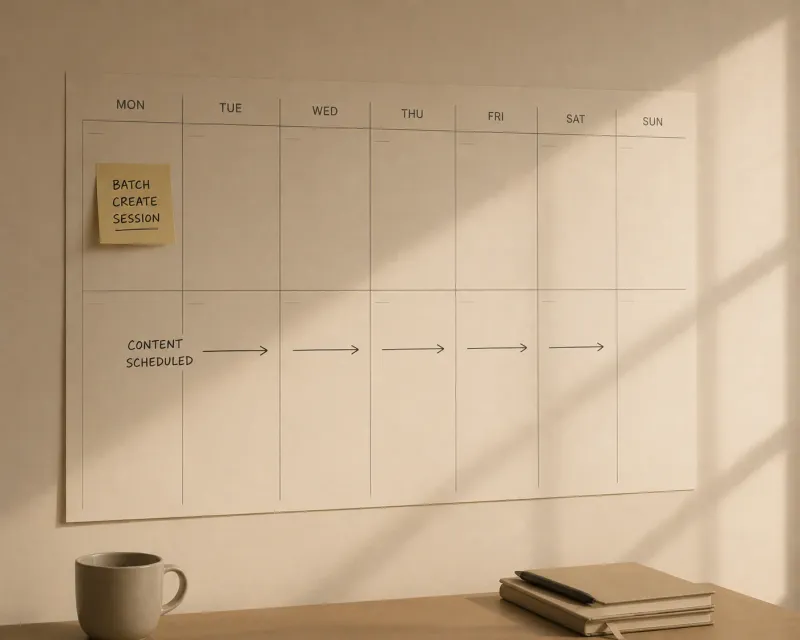

Batching can reduce daily decisions, but it does not remove the work of finding useful things to say. See when this Instagram system fits a small business and when it becomes another job.
You’ve probably read some version of this advice: instead of posting every day, sit down once a week (or once a fortnight), create all your content in a single session, schedule it all to go out automatically, and you’re done.
The appeal is easy to see: front-load the work, remove the daily decision, and let the scheduling tool handle the rest.
The method is sensible when a protected content session is genuinely available. The problem is that solo operators rarely have that kind of week, which is why the advice so often fails to stick.
What the batch-and-schedule method is
Batching means creating all your Instagram content in a single dedicated session rather than approaching each post individually as it comes up. A typical recommendation looks something like this: block out two to four hours, plan your content for the week ahead, write all the captions, prepare the photos, and schedule everything using a tool like Buffer, Later, or Hootsuite. Then step away and let the posts go out on their own.
The scheduling layer is what makes it work in theory: once the session is done, you don’t need to actively manage any individual post day. You’ve already handled the week.
Buffer’s own small business content guide recommends this approach explicitly, noting that batching removes the constant mental overhead of daily content decisions. Hootsuite’s research suggests that scheduled posts on a consistent cadence significantly outperform ad-hoc posting in reach and engagement over time.
What it gets right
Batching is a legitimate solution to a real problem, and it deserves to be taken seriously before being adapted.
It front-loads the creative work. When you sit down specifically to create content, you’re in the right mode for it — writing, choosing, deciding — rather than trying to switch into that mode mid-business-day. Concentrated creative time produces better output than scattered individual attempts.
It removes the daily question. “What should I post today?” is a question that costs energy every time you ask it. Batching answers it once for the entire week. You don’t think about Instagram on Tuesday because Tuesday’s post is already scheduled.
Scheduled posts don’t need you. Once content is queued, it goes out regardless of how your day is going. If Wednesday ends up chaos, the post still happens. This is a genuine advantage over posting in the moment.
It creates consistency by design. Regularity in timing — posting on roughly the same days each week — signals to both Instagram’s algorithm and your audience that you’re active and reliable. Batching makes regularity achievable without daily effort.
Where it breaks for solo business owners
The protected session rarely survives contact with the real week.
A two-to-four-hour block is a large claim on a solo operator’s time. Batching requires that nothing else takes priority during that window — no client emergency, no delivery, no phone call, no problem that needs solving now. In practice, this window is the first thing that gets cancelled when the business needs something.
It’s not a scheduling failure. It’s that the business reliably outranks a content session when both need your attention simultaneously.
Concentrated creative energy is hardest on the day you set it aside.
Even when the batch session does happen, it asks for creative output in a concentrated form. Writing three weeks of captions in one sitting is genuinely demanding — and it’s hardest when you’re also carrying the mental weight of running the business that week.
The result is often lower-quality content than you’d produce in short bursts, because the session happens when you’re already cognitively tired rather than at your peak.
Batched content goes stale.
This is the problem that’s underestimated most. You batch your content on Sunday. By Thursday, a seasonal shipment arrived, a client moment happened, a trend changed. The scheduled post about something else now feels disconnected from what’s actually going on in your business.
Real businesses are responsive. Something happened today that your clients would find interesting. A batch scheduled two weeks ago can’t include it.
The batch session sounds like freedom. In practice, it requires a protected block that the business keeps reclaiming.
Our take
Batching is right about the underlying problem: the daily decision of “what do I post?” is costly, and removing that cost is worth doing. We agree with that completely.
Where it falls short is the delivery mechanism. A large protected block is the wrong unit of time for most solo operators. The business doesn’t leave that block alone.
The alternative: micro-sessions. Rather than one large batch, short bursts of 10–15 minutes matched to the natural rhythm of the week. When something interesting happens today — a result you’re proud of, a client moment, a seasonal change — you capture it today. You’re not waiting for Sunday’s batch session.
This also means your content stays current. It reflects what’s actually happening in your business, not what you thought might happen when you were planning two weeks ago.
| Batch-and-schedule approach | Micro-session approach (Story Inventory) |
|---|---|
| Requires a 2–4 hour protected block each week | 10–15 minutes per post, spread through the week |
| Content is planned in advance, may feel stale when it posts | Content reflects what's happening in the business right now |
| Block is frequently cancelled when the business needs you | Short sessions fit around what the business demands |
| Creative output is concentrated — easier on a good week, harder on a bad one | Each session is short enough that energy cost is low |
| Scheduling tool adds friction and learning curve | Review a draft, edit, post — no additional tools required |
Story Inventory supports this approach directly: it generates a draft when you’re ready, in the time you have, based on what’s happening in your business right now. You’re not blocked by whether last Sunday’s batch session happened.
The Posting Planner helps you build a realistic rhythm around your actual week — one that doesn’t depend on a protected session that keeps getting cancelled. And the Post Idea Generator makes the 10-minute window productive from the first second: you have an idea to work with before you open the caption box.
If you want to compare batching to the other systems we’ve reviewed in this series, our take on the content pillars method and our review of Gary Vee’s Document and Distribute approach both address the same underlying challenge from different angles.
Questions about batching social media content for small businesses
What is social media batching?
Batching means creating all your social media content for a week (or longer) in a single dedicated session, rather than handling each post individually on the day it goes out. Once the content is created, it’s scheduled to post automatically using a tool like Buffer, Later, or Hootsuite. The idea is to front-load the creative work and remove the daily overhead of deciding what to post.
Does batching social media content actually work?
It works well in the right conditions: when you have a genuinely protected block of time each week, when the batch session actually happens consistently, and when your business content can be planned far enough in advance to still feel relevant when it posts. For marketing teams and businesses with stable, predictable content, batching is excellent. For solo operators with highly responsive, day-to-day businesses, the conditions for batching rarely stay intact for long.
How often should I batch my Instagram content?
The typical recommendation is once a week (for a week’s worth of content) or every two weeks (for a fortnight). If you’re going to try batching, a weekly session is more sustainable than a fortnightly one — two weeks of content is a lot to produce in one sitting, and content batched that far in advance tends to feel more disconnected from what’s actually happening in the business.
What's a good alternative to batching if I can't find time for a dedicated session?
Micro-sessions: very short bursts of posting (10-15 minutes) scattered through the week rather than one large session. When something interesting happens in the business today, you capture it today. You’re not waiting for the batch window. This keeps content current, reduces the risk of the session getting cancelled, and lowers the cognitive cost per post significantly.
What are the best tools for scheduling Instagram content?
The most commonly used for small businesses are Later, Buffer, and the native Meta Business Suite. All of them allow you to schedule posts in advance and manage a content queue. The limitation to be aware of: scheduling tools require having content to schedule — they solve the distribution problem, not the creation problem. If the batch session doesn’t happen, there’s nothing to schedule.