
Taking a break from Instagram does not just pause reach. It also removes reminders, proof, and opportunities for people who are deciding whether to contact your business.
You know you’ve gone quiet. You’re not sure exactly how long — ten days, maybe three weeks. You’ve been meaning to post. Things have just been busy.
The story you’re telling yourself is that it’s fine. A small gap. Easy to recover from.
But the gap has a cost that most people don’t account for until it’s already compounded.
What inconsistency actually costs
Most advice about Instagram consistency focuses on the algorithm. Post regularly or your reach drops. The algorithm punishes inactivity.
This is partly true. Instagram does favour accounts that post consistently. But the algorithm cost is smaller and more recoverable than the other cost — the one that doesn’t get talked about nearly enough.
Trust erosion.
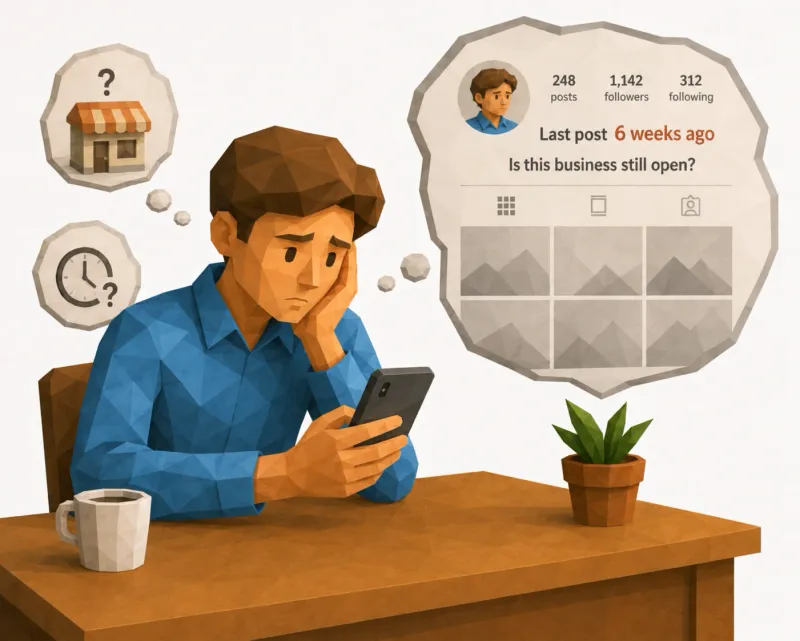
When a potential client lands on your profile and your last post was from six weeks ago, they don’t think: “Ah, they’ve been busy.” They think: Is this business still open? Has something changed? Is this someone I can rely on?
They don’t say any of this aloud. They just scroll past.
There’s a second cost that’s also underestimated: the rebuild cost. Coming back to Instagram after a gap is harder than maintaining a rhythm. You’ve lost the familiarity. The momentum. You have to re-earn the attention you’d already built, rather than building on it.
Why going quiet isn’t a discipline problem
Here’s what I want to say clearly: if you keep stopping posting on Instagram, it is almost never a motivation problem.
It’s a cost problem.
When any task consistently costs more energy than you have available at the end of a working day, you defer it. That is not a character flaw. It is a rational response to genuine cognitive depletion. Running a business is already demanding. Creating content on top of it — from scratch, every time, with a blank screen and no starting point — is genuinely hard work.
The cycle that follows is predictable: post consistently for a week or two → get busy → skip a few days → the gap grows → starting again feels harder than before → go quiet for longer → repeat.
Each pass through this cycle leaves you more exhausted and more reluctant to try again.
You're not inconsistent because you lack discipline. You're inconsistent because the cost of showing up is higher than the system can sustain.
What you could do manually
The standard advice here: build a content bank. Write ten captions in advance during a quiet afternoon. Batch your content on Monday. Schedule everything and let it run.
This is reasonable. It addresses the right problem — reducing the in-the-moment decision load by doing the thinking in advance.
In a well-resourced situation, it works. A dedicated block of time every week, a clear set of content themes, a reliable habit over time. The system runs smoothly.
Where it breaks for a real business
The quiet afternoon never comes. The Monday content session gets pulled by a delivery, a client emergency, the thing that actually needs handling right now. The content bank runs dry, and the pressure of refilling it becomes another source of dread.
The manual approach doesn’t fail because you’re not trying hard enough. It fails because it requires large, reliable blocks of creative energy that the average working week doesn’t consistently contain. Batching only works if the batch session happens. Scheduling only works if you have content to schedule.
Most importantly: willpower-based systems break at exactly the moment you need them most — when you’re busy, tired, and already context-switching between everything else the business demands.
What changes when the cost of showing up is lower
The solution to the inconsistency cycle isn’t more discipline or a better planning system. It’s lowering the cost of showing up on any given day.
When the cost of posting drops — from “sit down, decide what to post, write from scratch, second-guess it, post or give up” to “review a draft that already fits your business, edit it until it sounds right, post” — the cycle breaks.
Not because you’re suddenly more motivated. Because the task no longer costs enough to justify deferring.
| High-cost setup (no system) | Low-cost setup (with Story Inventory) |
|---|---|
| Decide what to post from scratch every time | Review a draft already matched to your business |
| Write the caption from a blank screen | Edit rather than invent — 5-10 minutes instead of 20+ |
| Second-guess whether it sounds like you | Your brand voice is already in the draft |
| Give up and try again tomorrow | Post, move on, know you'll have a starting point next time |
| Go quiet for two weeks | Post on Wednesday because the friction is gone |
This is exactly what Story Inventory was designed to do. Not to replace your voice — the 20% that only you can do stays with you. But to remove the blank screen and the setup cost that makes the task expensive enough to defer.
The Posting Planner is worth a few minutes if you want to find a rhythm that fits your actual life rather than an ideal one. And the Post Idea Generator gives you a few starting points matched to your business type so you’re never starting from nothing.
The honest version
Gaps are inevitable. Business gets busy, life interrupts, and some weeks will disappear.
The question is whether the gap is two days or three weeks. And whether coming back is easy or another full restart.
The difference is usually the setup cost. If posting requires a fresh idea, a caption, and a confidence check, deferring it feels rational. Lower that cost and showing up becomes the default.
A system that works when you’re tired, busy, and not feeling creative — that’s the one that breaks the cycle.
Questions about inconsistency on Instagram for small businesses
Why do I keep stopping posting on Instagram?
Most likely because the cost of posting — deciding what to say, writing from scratch, worrying whether it’s good enough — is higher than what you have left after a full working day. This isn’t a motivation problem. When a task is genuinely expensive and not immediately urgent, we defer it. The fix is reducing the cost of the task, not asking more of yourself.
Does going quiet on Instagram hurt your account?
Yes, in two ways. The algorithm does prefer consistent posting, though this is more recoverable than most people think. The larger cost is trust erosion: when someone lands on a profile with a six-week-old last post, the unconscious signal is that something has changed or the business is no longer active. That signal affects whether they take the next step.
How do I get back on Instagram after a break?
Without fanfare. Don’t announce the return, don’t apologise, don’t make it an event. Just post something real and normal — a piece of your work, a tip, something happening in the business right now. One post doesn’t restart a presence. Consistent posting over the next two weeks does. The bar for re-entry is much lower than it feels.
How long does it take to rebuild Instagram reach after going quiet?
Usually 2–3 weeks of consistent posting to recover the reach and engagement you had before the gap. The algorithm is fairly forgiving. The trust signal with new visitors takes slightly longer — your profile needs to look actively used before it reads as a reliable, open business. This is another argument for consistency over bursts: maintaining momentum is always cheaper than rebuilding it.
How do I stay consistent on Instagram when I'm busy?
The key is removing the setup cost of posting — the decisions, the blank screen, the creative work that has to happen before a single post goes out. If posting takes 5-10 minutes rather than 30, you’ll do it when you’re busy. If it takes 30, you’ll defer it. A system that gives you a starting point rather than requiring you to invent everything from scratch makes the difference between posting on a Wednesday and not posting at all.