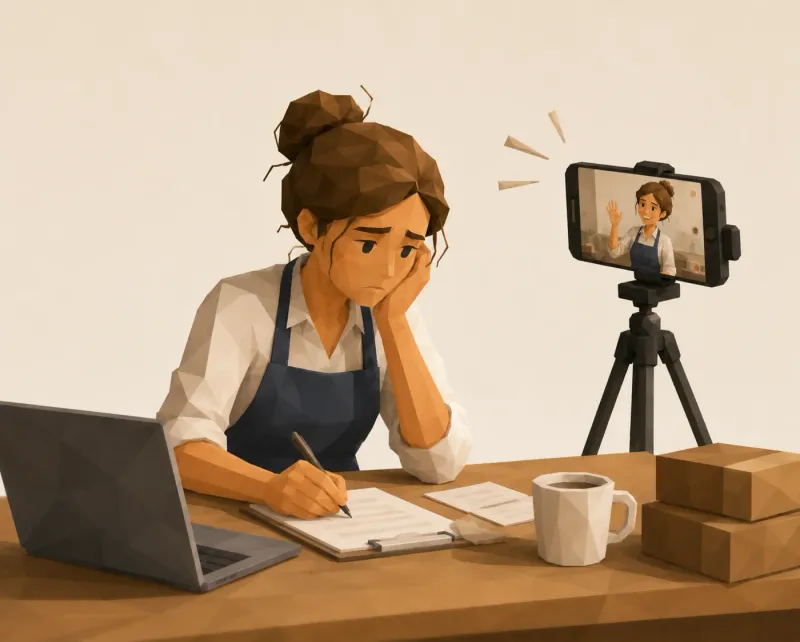

Documenting the work can make social content easier, but the method still needs selection and a point of view. Here is what it gets right and where it strains for independent businesses.
If you’ve spent any time following social media advice, you’ve probably come across Gary Vaynerchuk’s “Document, Don’t Create” philosophy.
The idea: stop manufacturing content. Instead, capture what’s already happening — your work, your day, your process — and distribute it across platforms. Be a documentarian of your real life, not a content creator trying to perform.
The core insight is sound: real work is usually more interesting than manufactured content. But the method assumes a person and production setup that may not resemble a nail salon, bakery, or flower shop.
The useful test is what happens after the moment has been documented, when the writing and distribution still belong to one busy owner.
What the Document and Distribute method actually is
Gary Vaynerchuk’s original argument was aimed at entrepreneurs who were paralysed by the idea of creating content — people who thought they had nothing interesting to say or didn’t know how to “do” social media.
His answer: stop trying to create. Start documenting.
Film the meeting. Share the thought you had in the car. Show the behind-the-scenes of your actual workday. Post the real, imperfect thing rather than a polished version of it.
Then distribute: take that documented moment and repurpose it across every platform — Instagram, TikTok, YouTube, LinkedIn. The same raw material, formatted for each context.
The premise is that you’re already living content-worthy moments every day. You don’t need to manufacture anything. You just need to stop hiding it.
What it gets right
The Document and Distribute method makes several genuinely correct observations about how small businesses can show up online.
It removes the pressure to perform. The advice gives you permission to show the real, imperfect thing rather than staging content. For businesses where the actual work is compelling — a florist building an arrangement, a baker pulling trays from the oven, a tattoo artist working through a detail — this is liberating.
It scales with your output. If you made five arrangements today, you have five potential pieces of content. You’re not inventing anything. You’re just showing what’s already there. The content comes from the business, not from a separate creative session.
It aligns Instagram with real work. The most compelling content for a local business usually is the real work. Not designed graphics. Not caption templates. The actual thing happening. Document & Distribute is built entirely on this insight, and it’s right.
It’s genuinely low-production. A phone, a brief caption, a post. No studio, no professional equipment, no script. The barrier to entry is as low as it can be.
Where it breaks for solo business owners
The Document and Distribute method was developed around Gary Vaynerchuk’s personal situation — which includes a full team at VaynerMedia dedicated to following him and processing his raw footage into platform-specific content. He documents. His team distributes.
For a solo operator doing everything herself, the distribute half of the equation is a full-time job on its own.
It’s built for personal brand, not service brand. Gary Vaynerchuk is the product. Every document-the-day post builds him directly. For a florist, a nail technician, or a salon owner, the product is the work — not the person. Documenting her day has value, but it needs to build trust in the business, not just in her personality. That’s a meaningfully different editorial challenge.
“Document everything” assumes comfort on camera. The method implicitly relies on video — filming yourself in the car, narrating what you’re doing, turning the lens on your work and your face. Many small business owners are not comfortable with this, and the method doesn’t offer an alternative. If you won’t do video, the whole “document your day” premise contracts significantly.
The written layer still needs to happen. Even if you’re documenting everything on camera, every piece of content still needs a caption, a context, a reason someone should care. Document & Distribute helps with the raw material. It doesn’t help with the writing.
“Distribute everywhere” doesn’t fit most local businesses. A florist in Bristol does not benefit meaningfully from being on LinkedIn, YouTube, and TikTok simultaneously. Her audience is local, and her priority platform is Instagram. Multi-platform distribution requires either significant time or a team — neither of which most solo operators have.
The method says: document your life and the content will follow. For someone whose product is a service, not a personality, that translation isn't automatic.
Our take
The insight at the centre of Document & Distribute is one we agree with completely: you already have content. The work you’re doing every day is more interesting than most people realise. You don’t need to manufacture anything — you need to show what’s already there.
Where Story Inventory draws from the same well, differently: instead of asking you to document everything on video and distribute it across platforms, it starts from your business voice — how you’d describe a specific piece of work, a particular client, a detail that mattered about today — and builds the written layer from there. No camera required. No repurposing team. No multi-platform overhead.
The raw material is your actual business. The writing and the consistency are handled. What you keep is the voice.
If you haven’t yet put your business’s voice into words, the Brand Voice Finder does exactly that in about four minutes — and gives you the kind of short description that anchors every caption you write or generate. The Post Idea Generator then turns what’s already happening in your business into specific post ideas, so you’re never starting from an empty premise.
If you want to compare Document & Distribute to the other systems we’ve reviewed, the content pillars method review is a useful companion piece — both are trying to solve the same problem of sustainable consistency, and they each fall short in different places.
Questions about Gary Vee's content strategy for small businesses
What is Gary Vee's Document, Don't Create strategy?
It’s Gary Vaynerchuk’s advice to stop trying to manufacture polished content and instead document what’s already happening in your business and life. Film the real thing, post the imperfect moment, show the behind-the-scenes. Then distribute that raw content across all available platforms. The premise is that you’re already living content-worthy moments — you just need to stop hiding them.
Does document and distribute work for small businesses?
The core insight works: your real work is compelling content, and authenticity outperforms performance. The method itself is harder to apply directly, because it assumes comfort on camera, a multi-platform presence, and ideally someone to help with the repurposing and distribution. For a solo business owner, the “distribute” half especially is a heavy lift. The principle is worth keeping. The full system requires significant adaptation.
Do I need to be on video to use Gary Vee's content strategy?
Not technically, but the method implicitly relies on it. “Document your day” most naturally means filming yourself and your work. If you’re not comfortable on camera, the approach contracts to: take photos of what’s already happening, write a caption that captures the real moment rather than performing for the platform. That’s a perfectly good strategy — it just requires the writing layer that Document & Distribute doesn’t address.
Can a local service business use document and distribute?
Yes, with two adaptations. First: narrow it to one platform (Instagram) rather than trying to distribute everywhere. Second: focus on documenting the work, not the person — clients care about what you make and how you make it, not about your hustle narrative. A florist photographing the arrangement as it comes together, a baker showing the morning prep, a nail tech filming the detail work — that’s the document half, applied usefully.
What should I document if I run a local business?
The work in progress. The moment before the reveal. The detail most people never see. The thing a client said that surprised you. The seasonal change that affects what you’re making right now. What goes into the finished product — not just the product. These are the moments that build trust and familiarity with your audience over time, and they’re already happening in your business every day.