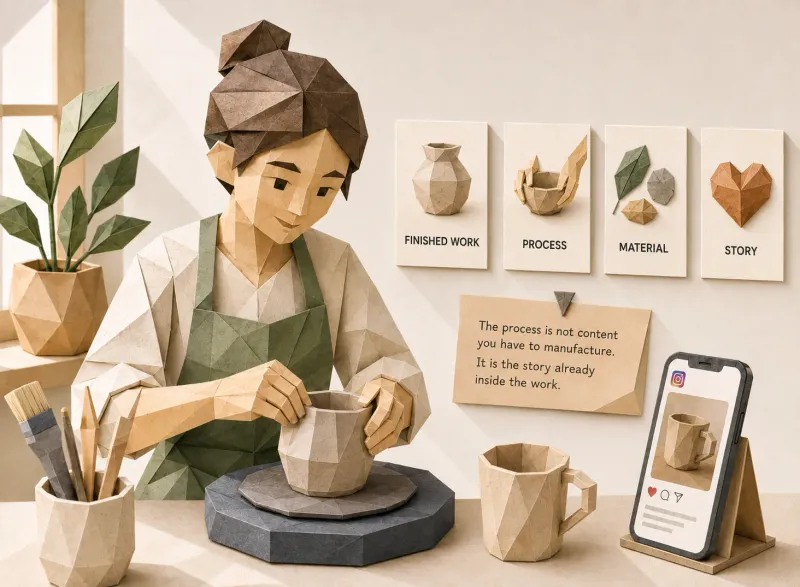

A practical Instagram content plan for makers and craft businesses, with ideas built around process, materials, finished work, and the story behind what you make.
For a maker, the finished product is only one part of the story.
The material, the process, the decisions, the failed attempts, the small detail that took three tries to get right: that is often what makes someone stop scrolling and remember who made the thing.
A product photograph tells people what is available. The making gives them a reason to care about it.
That does not mean turning your entire workshop into a content studio. It means noticing the parts of the work that already have texture, context, and a point of view.
The process is not content you have to manufacture. It is the story already inside the work.
Seven content types that work for makers
You do not need to document every step. Choose three or four types that feel natural and rotate them through the week.
Show the finished work properly
Start with the thing you made. Show the shape, texture, scale, colour, and the details that are easy to miss in a quick photograph.
A maker does not need a perfect studio image for every post. A clear close-up, a useful caption, and one sentence about the piece can be enough.
Explain what it is, what it is made from, how it is used, or what you noticed while making it. The image gets attention. The context helps it stay in someone’s mind.
Show the process
Process is often the most powerful content a maker has because it reveals time, skill, and decisions.
- Clay being shaped before firing
- A candle being poured and left to set
- A stone or metal being prepared for a piece of jewellery
- A glaze test, scent combination, or material sample
- Tools arranged before a work session
- The moment a rough form becomes recognisable
You do not need to explain every technical detail. Choose one step and say why it matters.
Explain the material
Materials carry useful stories. Where did they come from? What does the maker look for? Why did you choose this clay, wax, stone, thread, wood, or glaze?
Material posts also help customers understand variation. Handmade objects may have small differences in colour, texture, or shape. Explaining that difference turns it from a possible surprise into part of the value.
Share the decision behind a piece
A finished object contains dozens of decisions that the customer cannot see immediately.
Why this size? Why that shape? Why a matte finish instead of gloss? Why a clasp that sits this way? Why make a set rather than a single piece?
One decision makes a strong post because it gives the object a point of view. You are not only showing what you made. You are showing how you think.
Document what did not work
A failed test can be useful when you share the lesson rather than perform failure for attention.
A glaze turned out darker than expected. A scent combination was too strong. A handle cracked in the kiln. A clasp did not sit properly. Explain what changed in the next version.
This kind of post builds trust because it shows care. It also reminds people that handmade work is a process, not an instant output from a perfect machine.
Show the maker’s world
The person behind the work matters, especially when the object is identity-led or bought as something meaningful.
Share what you keep returning to, the references you notice, the colours you are drawn to, the objects you use every day, or the standard you refuse to compromise on.
This does not require a personal diary. A clear point of view is personal enough.
Make the next step easy
Tell people what is available and how to buy it. Mention a shop update, a collection release, a commission process, a market date, or the expected dispatch window.
A beautiful process post should not leave someone interested with no idea what to do next.
Be specific and calm. “The new mugs are in the shop from Friday” is more useful than “Something exciting is coming soon.”
Ideas for pottery businesses
Pottery naturally gives you a sequence to work with: clay, form, drying, firing, glazing, and the finished piece.
- A close-up of a texture or glaze variation
- Why you chose a particular clay body
- What happens before a piece enters the kiln
- A kiln opening with one thing you noticed first
- A shape you are refining and what changed
- How a piece is used in an ordinary home
- A small batch with the differences between each piece
- Care information for someone buying their first handmade ceramic
Avoid presenting natural variation as a defect. Explain what is intentional, what is expected, and how to care for the finished object.
Ideas for candle businesses
Candle content can become repetitive when every post is only a product photograph. Give the scent, testing, materials, and setting a place in the account.
- How you develop or choose a scent combination
- A note about wax, wick, vessel, or burn testing
- The mood or setting a scent was designed for
- A packing or labelling moment
- What you changed after a test burn
- How to use and care for the candle safely
- A seasonal collection explained without manufactured urgency
- The difference between two scents that customers often confuse
Safety information is useful content, not an interruption to the aesthetic. Clear instructions help people use the product with confidence.
Ideas for jewellery businesses
Jewellery content benefits from detail and context. Show scale, movement, materials, and how a piece sits when it is worn.
- A close-up of the texture or setting
- Why you chose a particular stone or metal
- How a clasp, chain, or fastening works
- The difference in scale between pieces in a collection
- A styling suggestion grounded in a real outfit or occasion
- How you check the finish before packing an order
- The story or reference behind a collection
- Care and storage guidance
If a material has ethical or sourcing considerations, explain what you know accurately. Specific information is more trustworthy than a broad claim about being responsible.
A simple three-post week
If you want a starting rhythm, use this:
- Finished work: show one piece clearly and explain one detail.
- Process or material: show how it was made or why a material matters.
- Maker’s point of view: share a decision, lesson, care note, or honest availability update.
That gives the account a balance of object, craft, and person. It also gives someone considering a purchase more than one photograph to base the decision on.
The Post Idea Generator can turn a material, process step, or current collection into more specific angles. The Brand Voice Finder is useful when the maker’s voice is clear in person but difficult to put into captions.
For a routine that survives weeks spent making, packing, and fulfilling orders, use the Calm Visibility Routine as a smaller starting point.
What to do when the work feels too ordinary to share
The part that feels ordinary to you may be the part a customer has never seen.
You know the steps because you repeat them. Someone discovering your work sees the material, tool, or decision for the first time. Do not wait for a dramatic story. Show one thing you noticed today and explain why it matters.
The aim is not to make every post profound. It is to make the work legible and memorable.
The practical default
Photograph one finished piece, one stage of the process, and one detail that shows how you think. Write a short caption for each. Add the buying information where it belongs.
You do not need to become a lifestyle creator. You need to let people see enough of the work that the object has a place in their mind before they decide whether to buy it.
Questions about Instagram for makers and craft businesses
What should a maker post on Instagram?
Show the finished work, the process, the materials, the decisions behind a piece, useful care information, and the person or point of view behind the business. Rotate three or four of those types rather than posting only product photographs.
Why is process content useful for a craft business?
Process content helps people understand the time, skill, materials, and decisions behind the finished object. It gives the product context and shows why handmade work is not interchangeable with a generic item photographed in the same way.
What should a pottery business post on Instagram?
Share finished pieces, glaze or texture details, kiln and making moments, material choices, care advice, small batches, and the decisions behind a shape. Natural variation can be explained as part of the handmade process rather than hidden.
What should a candle business post on Instagram?
Explain scent development, wax and wick choices, testing, vessels, safe use, packing, and the setting a collection was designed for. Product photographs work better when the caption gives people a reason to remember the scent or understand the product.
How often should a maker post on Instagram?
Three useful posts a week is a reasonable starting point: one finished piece, one process or material post, and one maker point-of-view or availability post. Choose a lower frequency if that is what you can sustain during production and fulfilment weeks.