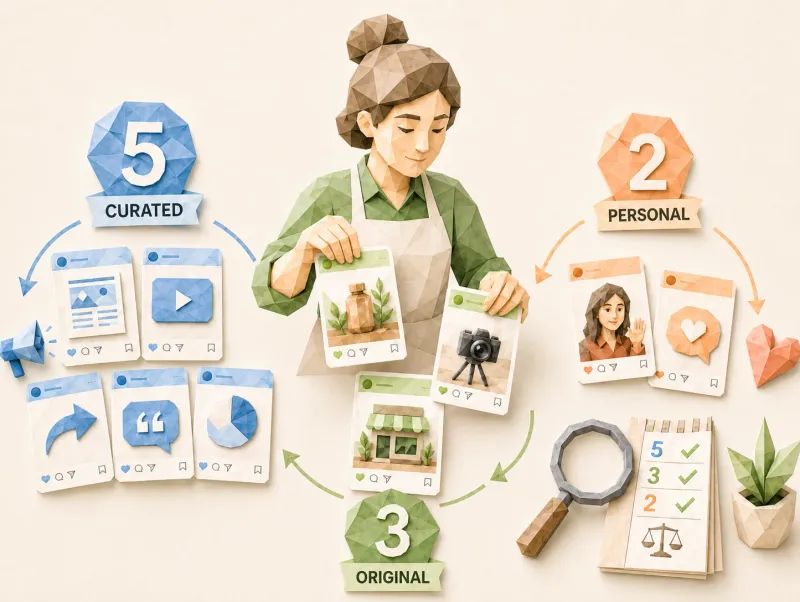

The 5-3-2 rule aims to balance curated, original, and personal content. Here is what the framework gets right, where it breaks for solo businesses, and a simpler version to try.
The 5-3-2 rule is one of those content frameworks that looks reassuring at first.
For every ten pieces of content, publish:
- 5 curated pieces from other people
- 3 original pieces from the business
- 2 personal pieces that show the people behind it
The appeal is obvious. It gives you a mix. Your account is not only selling, not only talking about itself, and not only reposting other people’s work.
The problem is the number.
For a solo business owner, ten pieces of content is already a meaningful production unit. Adding five third-party posts every week can turn a useful balance rule into another job: find something worth sharing, check whether it is relevant, write the introduction, credit the source, and make sure the post still fits the business.
The useful idea is balance. The original ratio is not a law.
Keep the balance. Drop the quota.
What the 5-3-2 rule is trying to prevent
The framework responds to three common problems.
An account that only sells
If every post is an offer, an appointment reminder, or a product photo with a price, people have little reason to follow between purchases. The account becomes a catalogue with a caption attached.
Curated and personal content create breathing room. They give people something useful or human to notice before they need to buy.
An account with no point of view
Original content gives the business a reason to exist in the feed. It shows how you work, what you notice, what you make, and what customers can expect.
Without it, the account may look active while remaining hard to remember.
An account that feels distant
Personal content helps people understand who is behind the work. That does not mean sharing your private life. It can be a decision, a preference, a small story, or a glimpse of the person delivering the service.
For a local business, familiarity is part of trust.
What the mix gets right
The 5-3-2 rule is useful as a prompt to look at the whole account rather than one post at a time.
It prevents one-note content. A feed made entirely of finished work can be visually strong and still leave people unsure how the business operates or whether they would feel comfortable choosing it.
It makes room for other people’s expertise. Sharing a useful article, local event, supplier story, or relevant idea can make an account more helpful without requiring the owner to be the only source of information.
It treats the business as more than a product. People choose local businesses partly because of the way they work, the standards they keep, and the relationship they create. A balanced account can show those things without announcing them as claims.
Where it breaks for a solo business
Five curated posts are a lot of work
Curated content is not free content. You still have to find it, judge it, explain why it matters, credit the source, and decide whether it belongs on your account.
That might be worthwhile for a business whose audience needs regular industry news or commentary. It is less useful for a florist, salon, café, or maker whose strongest material is already happening in the business.
Five external posts can also drown out the reason someone followed you in the first place.
Personal does not have to mean private
The word “personal” can make business owners feel that they need to share family life, vulnerability, opinions, or daily routines they would rather keep to themselves.
They do not.
Personal content can mean a professional preference or a human detail: why you chose a particular material, what you always check before opening, how you learned a technique, or what you want customers to feel when they arrive.
You can make the business recognisable without making your private life public.
The ratio ignores the shape of the business
A yoga teacher may have plenty of useful original education to share. A boutique may naturally curate products and designers. A massage therapist may need more trust-building explanation before making a booking invitation.
The same ratio cannot know what each business needs to explain.
The right mix depends on the gap in the account, not on a universal quota.
A simpler version for small businesses
Use three content types instead of ten fixed slots:
- Work: what you make, do, teach, or help with.
- Useful context: answers, explanations, process details, or relevant ideas.
- Human signal: the point of view, standards, and people behind the business.
Start with one post from each category every week. Add a fourth when the business has something genuinely current to share. That gives you variety without requiring five external posts before you are allowed to talk about your own work.
| 5-3-2 approach | Business-sized version |
|---|---|
| 5 curated posts from other people | Useful context from customer questions, your process, or one relevant outside source |
| 3 original posts | Work: results, products, services, and what is happening now |
| 2 personal posts | Human signal: preferences, standards, story, and the people behind the work |
| Fixed ten-post ratio | One post from each category, then adjust when the business needs something else |
How to apply it without creating another system
Look at your last ten posts once a month. Do not score them with a spreadsheet. Ask:
- Can someone understand what we actually do?
- Have we answered anything useful?
- Have we shown how the business works or what we care about?
- Is there a natural next step for someone who wants to enquire?
- Are we sharing outside content because it helps customers, or because the calendar says we should?
If the answer to one question is no, make the next post address that gap.
The Post Idea Generator can help when you know which category is missing but not the angle. The Posting Planner can help you choose a frequency that fits the week rather than building a schedule around ten posts at a time.
If the larger problem is starting at all, the Calm Visibility Routine uses three small creation windows and a short review instead of a large content quota.
The practical default
Treat 5-3-2 as a useful check for variety, not a publishing obligation.
For most solo businesses, start with:
- one post showing the work
- one post answering a useful question
- one post showing the human point of view behind the work
That is enough to make the account feel more complete. If you have a genuinely relevant article, local event, supplier story, or customer resource, share it when it helps. You do not need to manufacture five curated posts to prove that the account has balance.
A framework is doing its job when it reduces decisions. Once it starts creating decisions you did not need, simplify it.
Questions about the 5-3-2 content mix rule
What is the 5-3-2 rule for Instagram?
The 5-3-2 rule suggests that for every ten pieces of content, five should be curated from other sources, three should be original content from the business, and two should show the people or personal side behind the business. It is intended to create variety rather than make an account feel like a constant sales catalogue.
Does the 5-3-2 rule work for small businesses?
The principle of variety can help, but the fixed ratio may create unnecessary work for a solo owner. Five curated posts require research, judgment, context, and crediting. A simpler starting point is one post showing the work, one useful or educational post, and one human or process post each week.
What counts as personal content for a business?
Personal content does not have to mean private content. It can show your professional preferences, standards, decisions, story, or the people behind the work. Share what helps customers understand the business while keeping the boundaries that feel right to you.
Do I need to share other people's content on Instagram?
No. Share outside content when it is genuinely useful or relevant to your customers. If your own business already provides useful context, process knowledge, and original work, there is no reason to fill a quota of third-party posts.
How can I create a balanced Instagram feed without overplanning?
Review your last ten posts and identify what is missing: the work, useful context, or the human point of view. Make the next post address that gap. This gives you the benefit of a content mix without turning the account into a spreadsheet.