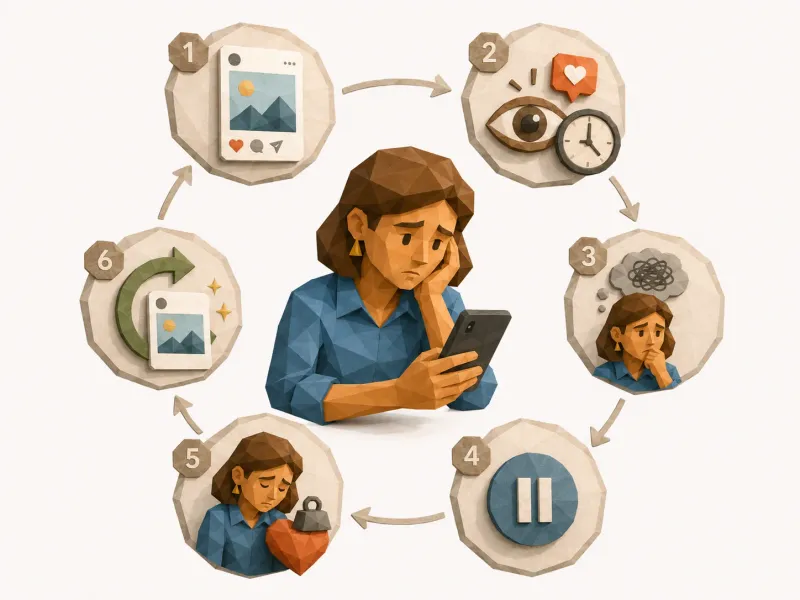

The cycle is not post, perform, succeed. It is post, wait, worry, stop, feel guilty, and start over. Here is why the loop happens and how to make it smaller.
You post something after a quiet week.
Then you check whether anyone saw it. You notice the likes. You wonder whether the caption was good enough, whether the photo was the right choice, and whether the people who need you are actually seeing any of it.
A few days later, the business gets busy. You do not post. Then you remember that you have not posted, feel bad about it, and decide you need to start again properly.
That is the Instagram guilt loop:
Post → wait for a verdict → feel exposed or disappointed → stop → feel guilty → restart with too much pressure.
It feels personal because you are the person holding the phone. The pattern is structural. The platform asks you to publish, perform, monitor, and interpret the response while you are also running the business.
The guilt is not proof that you care too little. It is often what happens when every post feels like a test.
Why one post starts to feel like a verdict
A small business post is rarely just a post in your head. It starts carrying several questions at once:
- Do people like what I do?
- Does this look professional?
- Will anyone book or enquire?
- Am I wasting my time?
- Does this sound like me?
- What if people I know think it is embarrassing?
Instagram gives you an immediate stream of numbers, but those numbers do not answer most of the questions. A quiet post can still have reminded someone that you exist. A liked post may not lead to a booking. A person may save a useful tip and contact you two weeks later.
When you expect one post to resolve the uncertainty, the waiting becomes exhausting.
The loop is built from four pressures
1. Exposure
Posting makes the work visible before you know how it will be received. That is uncomfortable even when you are confident in the business itself.
You can be certain that your haircut, arrangement, class, or product is good and still feel uncertain about presenting it online. The medium adds a performance layer that the actual work does not require.
2. Unclear feedback
Likes and views arrive quickly, but business value often arrives slowly and indirectly. The feedback is immediate enough to trigger emotion and incomplete enough to create doubt.
That is a difficult combination. You feel evaluated without receiving a useful answer.
3. A high starting cost
If the next post requires an idea, a photo, a caption, a decision about the format, and a confidence check, postponing it is rational. The task is expensive and the reward is uncertain.
A task that feels expensive will be deferred, even when you care about the outcome.
4. Restart pressure
After a gap, the next post feels like an announcement. You think you need to explain the absence, return with something impressive, or rebuild the whole plan.
That makes the first step heavier, which makes another delay more likely.
What the usual advice misses
The usual advice is to be more consistent, post more often, engage with your audience, and stop caring about the numbers.
Some of that is directionally right. None of it explains how to make the next post easier when you are already tired and the last post felt like a quiet judgment.
Telling someone not to care about the response does not remove the response. Telling them to post every day adds more opportunities to feel evaluated. A useful system has to reduce both the production cost and the emotional weight of each individual post.
Make each post smaller than your identity
The first practical change is to stop asking one post to represent the whole business.
A post can be:
- one answer to a customer question
- one current result
- one detail from the process
- one reminder that appointments or products are available
- one ordinary observation from the week
It does not need to prove that you are creative, strategic, interesting, or successful. It only needs to give the right person one useful or recognisable reason to remember you.
That distinction matters. A post is evidence of the business. It is not a referendum on the person running it.
Separate making from measuring
Do not write a post and immediately ask it to tell you whether Instagram is working.
Give the post one job. Publish it. Review patterns over a longer period: profile visits, enquiries, saves, repeat questions, and whether the people who contact you understand what you offer.
The Growth Diagnostic can help when you need to investigate what is and is not working. It is more useful as a periodic review than as a verdict attached to every post.
The Social Media Time Audit can help with the other side of the problem: how much time the platform is taking from the business. Measurement should help you make a decision, not create another obligation to monitor everything.
Interrupt the loop at the starting point
The easiest place to interrupt the cycle is before the blank screen appears.
Keep a short list of real moments from the business. When you have ten minutes, choose one and ask for three possible angles. Use the Post Idea Generator if you need help getting started. Then review the draft using the five questions in How to Review AI-Generated Instagram Posts.
The sequence matters:
- Start with something that actually happened.
- Choose one useful angle.
- Review a draft instead of inventing everything.
- Publish without demanding an immediate verdict.
- Return to the next real moment when the week allows.
You are building continuity, not trying to create a perfect comeback.
| Guilt loop | Lower-cost alternative |
|---|---|
| Post something impressive after a gap | Share one current, ordinary detail |
| Check the response as a verdict | Review patterns during a scheduled check-in |
| Feel bad when the week gets busy | Return to the next available business moment |
| Restart the entire plan | Continue with the next small post |
| Treat the post as a reflection of you | Treat it as one piece of evidence about the business |
The practical default
For the next two weeks, publish three small posts without trying to make any of them impressive. Give each one a clear job. Do not announce your return. Do not apologise for the gap. Do not rebuild your strategy after one quiet result.
At the end of the two weeks, look for useful signals rather than a single score: did people ask better questions, visit your profile, reply, enquire, or mention something you shared?
The way out of the guilt loop is not becoming indifferent. It is making Instagram too small to control your mood and useful enough to support the business.
Questions about Instagram guilt and social media pressure
Why do I feel guilty when I do not post on Instagram?
Posting may have become a promise you keep making without a system that makes it easy to keep. When the task has a high starting cost and the results are uncertain, you postpone it. The gap then creates guilt, which makes returning feel even harder. Reduce the size of the next step instead of using guilt as a planning tool.
How do I stop feeling pressured to post on Instagram?
Give Instagram a smaller role. Choose a realistic frequency, give each post one job, and separate publishing from performance checking. You do not need every post to grow the account. You need enough current evidence that the right people can recognise and trust the business.
Should I apologise for not posting on Instagram?
Usually, no. Most people did not experience your absence as an event. Return with something current and useful rather than making the gap the subject of the first post. A normal post makes the business feel active again without adding more emotional weight.
How can I post when I feel embarrassed or exposed?
Start with the work rather than a performance of yourself. Share a result, a process detail, a customer question, or something you made. Keep the claim specific and the next step natural. You can be visible without sharing more of your personal life than feels right.
How often should I check Instagram results?
Check often enough to notice useful patterns, not so often that every post becomes a verdict. A weekly or fortnightly review of profile visits, enquiries, saves, and customer responses is usually more informative than repeatedly refreshing the numbers after publishing.