
Influencer advice optimizes for attention and audience growth. A small business needs to build recognition, trust, and a reason to enquire, which calls for a different Instagram strategy.
Social media was made for influencers.
Posting every day. Sharing your morning routine. Building a personal brand. Growing a following. The whole playbook — it was designed for people whose job is the content.
You have a different job. You make the coffee. You cut the hair. You grow the flowers. You lay the tiles. You run the shop. Instagram is just supposed to help people find you.
The job is different, so the useful Instagram decision rule is different too. Advice built for someone whose income comes from attention is a poor fit for someone whose income comes from the work itself.
The influencer playbook — and why it was never written for you
The advice that dominates Instagram — “post every day,” “be relatable,” “let people into your life” — wasn’t written for business owners. It was written for creators.
An influencer’s product is them. Every post is the product. Their opinion on a trending topic, their morning routine, their take on the algorithm — all of it builds the following that earns the brand deal. Content is how they get paid.
That is not what you do. You get paid for the haircut, the coffee, the flower arrangement, the job well done. Instagram is supposed to help people find that thing — not become a second full-time job on top of it.
When a small business owner tries to apply the influencer model — posting constantly, performing their day, staying on top of every new format — of course it feels exhausting. Of course it doesn’t work. They’re playing a game with different rules using someone else’s rulebook.
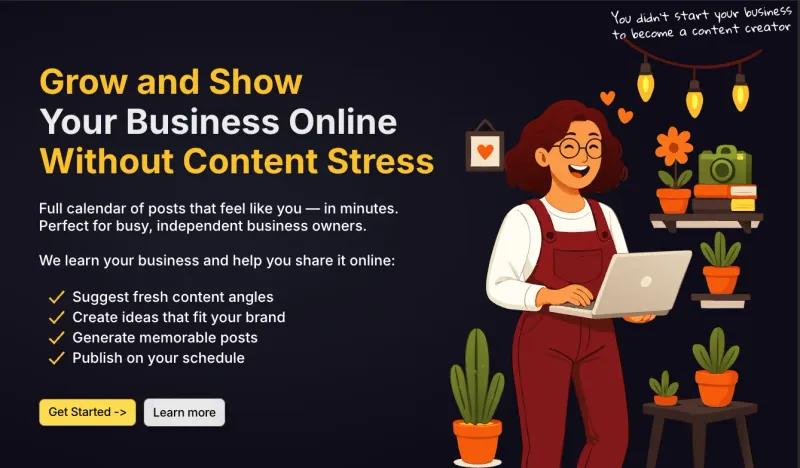
Social media was made for influencers. Running a real business is different. So we made a tool for independent businesses — not marketing teams.
This is who Instagram for real businesses is actually for
The distinction is practical: your work is the product, and Instagram is the route by which the right local customer finds it.
These businesses don’t need to go viral. They need to be visible to the people in their area who are already looking for what they offer. That is a completely different goal — and it requires a completely different approach.
What it actually looks like right now
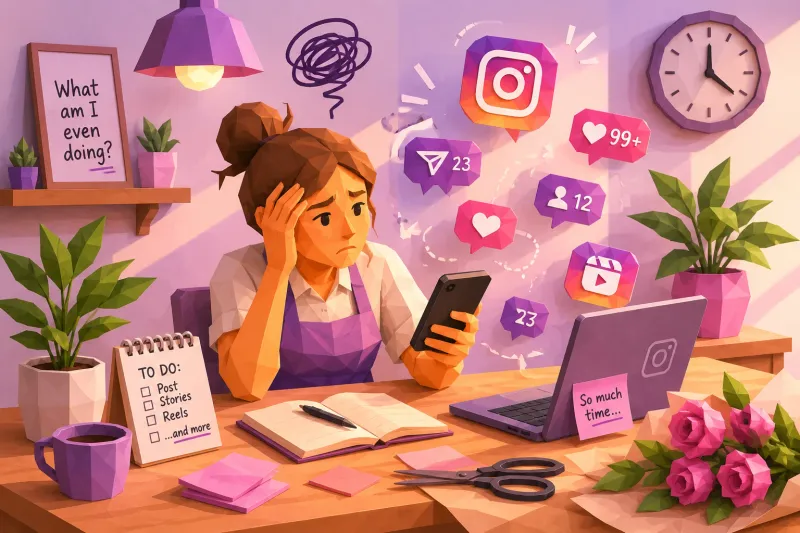
If you’re managing Instagram on your own, alongside everything else the business needs, it probably feels something like this:
| Reality today | With Story Inventory |
|---|---|
| Posting only when you remember | Posting regularly and staying visible |
| Never sure what to share | Content that feels like you |
| Running out of ideas | Ideas shaped around your business |
| Feeling pressure to stay active | Plan ahead and let it run quietly |
The gap between those two columns isn’t about talent, or time, or motivation. It’s about having a system built around the way your business actually works — not one borrowed from a creator who posts for a living.
You don’t need a personal brand. You need to be findable.
Here’s the reframe: you don’t need to become a content creator. You don’t need a large following. You don’t need to post every day, perform your personality, or keep up with whatever format Instagram is currently favouring.
You need to be visible enough that when someone nearby is looking for what you do, they find you — and when they land on your profile, they see a real, active, trustworthy business.
That’s it. For most small businesses, that means posting a few times a week, keeping it relevant to your actual work, and staying consistent enough that you don’t disappear for months at a time. You don’t need volume. You need enough.
If you’re unsure how to stay consistent without burning out, that’s worth reading separately — but the first step is stopping the comparison to people who do this for a living.
The Post Idea Generator gives you ideas shaped around your specific type of business — not generic tips, but things you can actually use this week.
It should still sound like you
The other thing that holds people back: the fear that using any kind of tool will make their content sound fake. Generic. Like it could have come from any business in your category.
That fear makes sense. A lot of AI-generated content does sound like everyone else — because it was trained on everyone else, without knowing anything about what makes your business different.
The answer isn’t avoiding tools. It’s using tools that actually know your business. Your tone. The way you’d describe your work to a customer. What makes you different from the café three streets over, or the other salon in the same postcode.
The Brand Voice Finder is how you tell Story Inventory what makes your business yours — so the ideas and captions it creates actually sound like you, not like a template version of a business like yours.
Questions about Instagram for real businesses
Do I need to post every day on Instagram?
No. Consistency matters far more than frequency. Later’s analysis of 19M+ Instagram posts found that most growing small business accounts average three to four posts a week — not daily. The goal is to not disappear for long stretches, not to hit a daily quota. Three good posts a week beats seven rushed ones.
Can a small business compete with influencers on Instagram?
You’re not competing with them — you’re doing something different. Influencers are trying to reach as many people as possible. You’re trying to reach the right people in your area or niche. A café doesn’t need a million followers. It needs to be the first place that comes to mind when someone nearby is looking for a good coffee. That’s a completely different measure of success.
What should I actually post if I'm not an influencer?
Your work. Your process. What’s new or in season. A question a customer asked this week. A small behind-the-scenes moment. What you made today. Most small businesses have far more worth sharing in their daily work than they realise — they just haven’t been shown how to see it yet.
Is Instagram even worth it for a local business?
Yes — but not for the reasons most people think. Hootsuite’s 2026 research shows that 80% of Instagram users follow at least one business account, and half discover new businesses simply by scrolling their feed. The platform is full of people looking for exactly what you offer. The question isn’t whether it’s worth it. It’s whether the approach you’ve been using was built for your kind of business.
How is Instagram different for a real business versus a content creator?
A content creator’s job is to grow a following. Their content is the product. A small business owner’s job is to run a business — Instagram is just the window that helps people find it. That changes everything: what to post, how often, what success looks like, and how much time it should take. You’re not a content creator who happens to run a business. You’re a business owner who needs to stay visible. Those are different jobs.
You don’t have to perform your work. You just have to show up for the people who are already looking for it.
For the full story of why we built Story Inventory — and who we built it for — read this →.