

Consistency comes from a repeatable system, not daily motivation. Build an Instagram routine that a solo business owner can maintain when the week gets busy.
If you’ve ever told yourself “I need to post more on Instagram” - and then disappeared for two weeks - I want you to know something first: that’s not a motivation problem. That’s not a discipline problem.
That’s what happens when you’re running a real business and Instagram is just one more thing sitting on top of everything else.
The pattern is predictable rather than unusual. You post with good intentions, things get busy, you drop off, and the gap starts to feel too large to come back from.
That cycle is exhausting. And the advice most people get - just be consistent! - doesn’t help at all.
What makes this worth fixing: Hootsuite’s 2026 Instagram research shows that 80% of Instagram users already follow at least one business account, and half of all users discover new brands, products, or services simply by scrolling their feed. When your account goes quiet, you’re not just missing a posting window - you’re invisible at exactly the moment someone might have found you.
Consistency isn't a personality trait. It's a system. If your system is broken, willpower won't fix it.
— My honest take after seeing this pattern too many times
Why staying consistent is actually hard (not just an excuse)
The difficulty has a specific shape:
When you’re running a business alone - or close to it - Instagram has to compete with real work for your attention. Replying to customers. Managing orders. Keeping the actual thing running. Posting is important, but it’s never urgent in the way that everything else is.
So it gets pushed.
And then when you do sit down to post, you realise you still have to:
- think of something worth saying
- decide how to say it
- second-guess whether it’s good enough
- actually post it
That’s four separate decisions for one piece of content. Four chances to get stuck and do something else instead.
The cycle I see business owners get stuck in
It’s almost always the same pattern, and it might feel familiar:
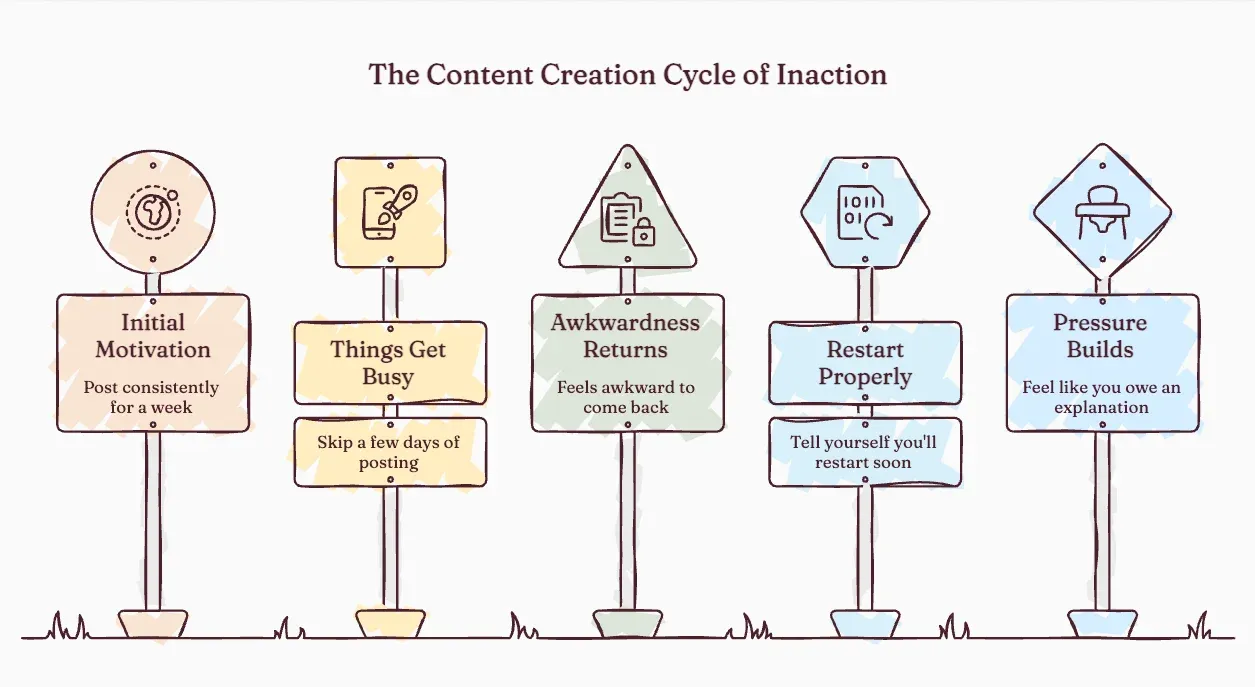
- You feel motivated → post consistently for a week or two
- Things get busy → you skip a few days
- A week passes → it starts to feel awkward to come back
- You tell yourself you’ll “restart properly” soon
- Repeat
The longer the gap, the more pressure builds. You start to feel like you owe your audience an explanation, or like you need a big comeback post to justify your absence. You don’t - but it feels that way. And that feeling is exactly what keeps people stuck.
What “consistent” actually looks like for a real business
Here’s the reframe I want to offer: consistency doesn’t mean posting every day. It means not disappearing for long stretches, and not starting from zero every time you sit down.
For most small businesses, that looks something like this:
| Posting frequency | Posts per week | What it requires | Who it suits |
|---|---|---|---|
| Minimal but present | 1-2 | One idea, one post - nothing fancy | Busiest periods, or just getting started |
| Steady rhythm | 3-4 | A loose plan and a few reusable formats | Most small businesses at a sustainable pace |
| Active growth mode | 5-7 | A proper content system and batching time | When Instagram is a primary growth channel |
| Daily posting | 7+ | Significant time investment or a team | Rarely the right move when you're doing everything yourself |
My honest recommendation for most small business owners: aim for the middle row. Later’s analysis of 19M+ Instagram posts found that accounts with under 10K followers average just 2 feed posts per week - and those growing toward 100K average 3. That’s it. Not once a day. Three to four posts a week, with a simple structure behind them, is enough to stay visible, build familiarity with your audience, and not burn yourself out within a month.
A practical system that actually works
The difference between people who post consistently and people who don’t isn’t discipline. It’s how much thinking they have to do each time.
Here’s the system I’d put in place:
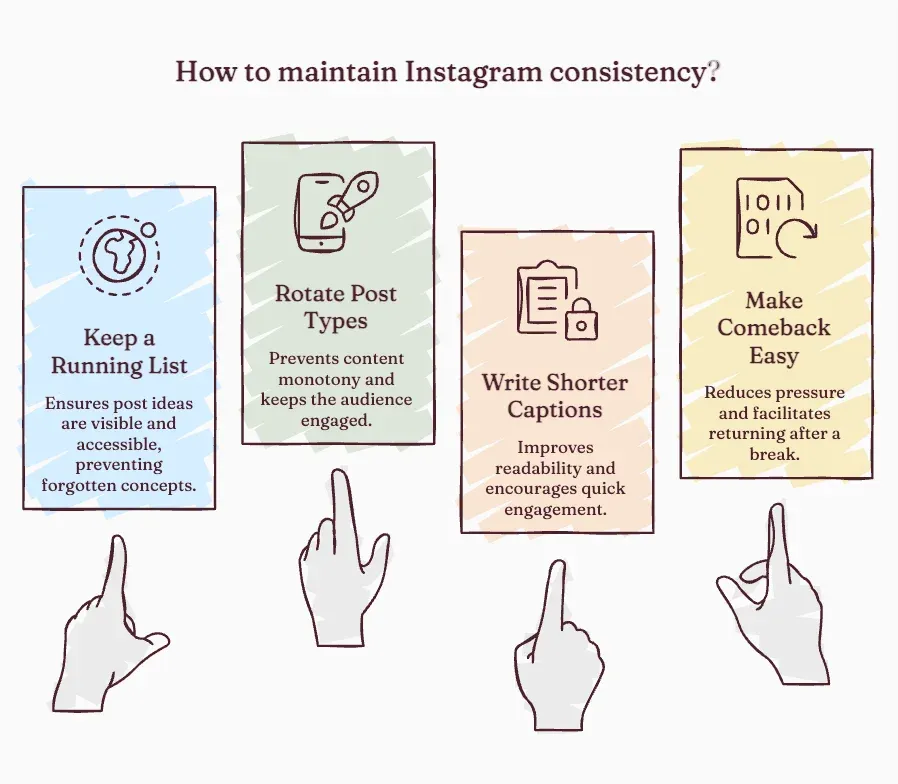
1. Keep a running list of post ideas - somewhere you’ll actually see it
Not in your head. Not in a fresh note you’ll forget about. Somewhere visible - your phone’s notes app, a sticky note near your desk, a voice memo.
Every time something happens in your business that could be interesting - a customer reaction, a new product, an observation, a small tip - log it. When it’s time to post, you’re choosing from a list. Not generating from nothing.
2. Pick three or four post types and rotate them
You don’t need a different format every day. In fact, rotating a small set of familiar types makes things easier because you already know what the post looks like before you start.
Some formats that work for most small businesses:
- “Here’s what we made / did today”
- “A behind-the-scenes look at how this works”
- “A small tip that might help you”
- “Something a customer often asks us”
That’s four formats. That’s a week of content without any original thinking about structure.
3. Write shorter captions than you think you need
This is the one I push back on most consistently. Business owners often write long, careful captions because they feel like they need to justify posting. They don’t.
Short and specific beats long and careful. “This week’s custom order - can you spot the ranunculus? They’re my favourite right now.” That’s a caption. Done.
4. Make it easy to come back after a gap
You will have weeks where you don’t post. That’s not failure - that’s running a business. What matters is that coming back doesn’t feel like a big deal.
No big “I’ve been absent” post. No apology. Just: “Here’s what’s happening today.” Pick up where you left off. Every account that’s been going for more than a year has gaps. Your audience doesn’t track them as closely as you do.
Where even good systems break down
I want to be honest about the limits of what I’ve described above. Even with a running list and a rotation of formats, there are still weeks where:
- you run out of ideas that feel fresh
- every caption sounds repetitive to you (even if it isn’t to your audience)
- you genuinely don’t have time to sit down and write anything
- it all just feels like too much
This is the point where most people stop again. Not because they don’t care - but because the system still requires energy they don’t have.
The hardest week to post isn't when you're busy. It's when you're busy *and* you can't think of anything to say.
A simpler way to stay consistent
This is the exact problem Story Inventory is built around.
Instead of figuring out what to post every time, it generates weekly post ideas for your type of business, suggests captions that sound like you, and helps you maintain a content presence without the mental overhead of doing it all from scratch.
It’s not about posting more. It’s about making posting feel light enough that you actually keep going - even in a busy week.
Questions I get about Instagram consistency
Is it better to post consistently at a lower frequency, or burst-post and go quiet?
Consistent at a lower frequency, every time. I can’t stress this enough. Three posts a week for three months will do far more for your account than twenty posts in one week followed by silence. The algorithm favours active accounts, and your audience builds recognition through repetition - not volume. Instagram’s own ranking documentation confirms this: the algorithm prioritises accounts that earn consistent early engagement - saves, comments, and shares in the first hour of posting - not accounts that show up once a month with a surge of posts.
Does the time of day I post really matter?
Less than you think, especially early on. Hootsuite’s analysis of 1M+ posts does show real patterns - engagement tends to peak in the late afternoon on weekdays - but the differences are modest, and they’re based on your specific audience, not a universal rule. It’s worth experimenting once you have a regular posting rhythm, but I wouldn’t let timing become a reason to delay. Post when it’s convenient for you. Getting it out consistently is more important than hitting the “perfect” window.
Should I batch my content in advance?
If it works for you, yes - batching can remove a lot of daily friction. But I’ve seen people spend hours batching content and then feel like they’ve done the work, when really the hard part is still showing up every day to actually post it. If batching helps you, great. If it becomes another procrastination tool, skip it.
What do I do after a long gap? Do I need to address it?
No. Just post something. Your audience has their own life - they’re not tracking your posting calendar. A long absence feels enormous to you and almost invisible to most of your followers. Return without fanfare: “Here’s what’s been happening” is plenty. The worst thing you can do is keep waiting for the “right” moment to come back.
How do I stay motivated to keep posting when I don't see results?
This one is hard, and I want to be honest: early-stage Instagram growth is slow and the feedback loop is weak. What helps is shifting the goal away from metrics and toward habit. Tell yourself you’re building a posting habit, not chasing follower counts. Results come with consistency over months - but the habit is what you can control right now.
If you take one thing from this
Don’t aim to fix your Instagram. Just aim to make it lighter.
A smaller, simpler system that you actually follow is worth a hundred elaborate content strategies that stay in a draft tab.
Start with a list of ideas. Pick two post types. Post something this week - even if it’s small.
The goal isn’t perfection. It’s showing up regularly, in a way that fits around your business - not on top of it.
And if you want something that removes most of the thinking entirely, Story Inventory is built for exactly that.
Start with the Sustainable Posting Planner to choose a rhythm, then use the Social Media Time Audit to find which part of the work is costing you most.