How to Stay Consistent on Instagram as a Small Business Owner
Consistency comes from a repeatable system, not daily motivation. Build an Instagram routine that a solo business owner can maintain when the week gets busy.

Consistency comes from a repeatable system, not daily motivation. Build an Instagram routine that a solo business owner can maintain when the week gets busy.
If you’ve ever told yourself “I need to post more on Instagram” - and then disappeared for two weeks - I want you to know something first: that’s not a motivation problem. That’s not a discipline problem.
That’s what happens when you’re running a real business and Instagram is just one more thing sitting on top of everything else.
The pattern is predictable rather than unusual. You post with good intentions, things get busy, you drop off, and the gap starts to feel too large to come back from.
That cycle is exhausting. And the advice most people get - just be consistent! - doesn’t help at all.
What makes this worth fixing: Hootsuite’s 2026 Instagram research shows that 80% of Instagram users already follow at least one business account, and half of all users discover new brands, products, or services simply by scrolling their feed. When your account goes quiet, you’re not just missing a posting window - you’re invisible at exactly the moment someone might have found you.
Consistency isn't a personality trait. It's a system. If your system is broken, willpower won't fix it.
— My honest take after seeing this pattern too many times
The difficulty has a specific shape:
When you’re running a business alone - or close to it - Instagram has to compete with real work for your attention. Replying to customers. Managing orders. Keeping the actual thing running. Posting is important, but it’s never urgent in the way that everything else is.
So it gets pushed.
And then when you do sit down to post, you realise you still have to:
That’s four separate decisions for one piece of content. Four chances to get stuck and do something else instead.
It’s almost always the same pattern, and it might feel familiar:
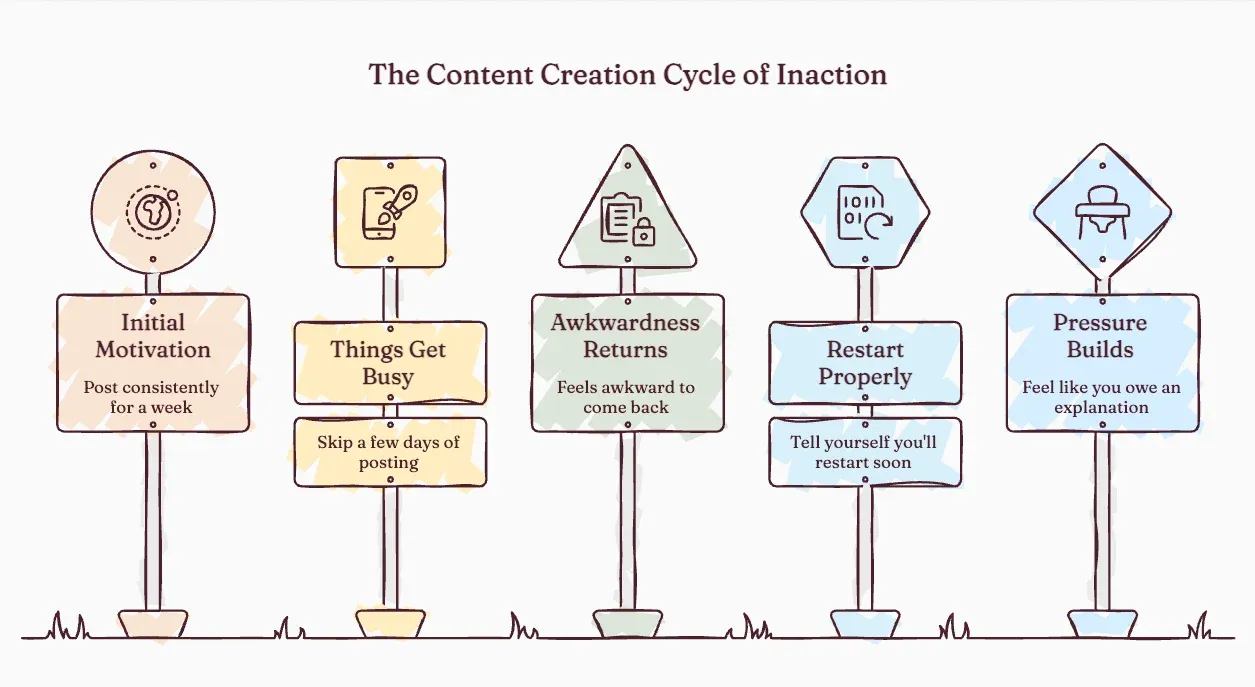
The longer the gap, the more pressure builds. You start to feel like you owe your audience an explanation, or like you need a big comeback post to justify your absence. You don’t - but it feels that way. And that feeling is exactly what keeps people stuck.
Here’s the reframe I want to offer: consistency doesn’t mean posting every day. It means not disappearing for long stretches, and not starting from zero every time you sit down.
For most small businesses, that looks something like this:
| Posting frequency | Posts per week | What it requires | Who it suits |
|---|---|---|---|
| Minimal but present | 1-2 | One idea, one post - nothing fancy | Busiest periods, or just getting started |
| Steady rhythm | 3-4 | A loose plan and a few reusable formats | Most small businesses at a sustainable pace |
| Active growth mode | 5-7 | A proper content system and batching time | When Instagram is a primary growth channel |
| Daily posting | 7+ | Significant time investment or a team | Rarely the right move when you're doing everything yourself |
My honest recommendation for most small business owners: aim for the middle row. Later’s analysis of 19M+ Instagram posts found that accounts with under 10K followers average just 2 feed posts per week - and those growing toward 100K average 3. That’s it. Not once a day. Three to four posts a week, with a simple structure behind them, is enough to stay visible, build familiarity with your audience, and not burn yourself out within a month.
The difference between people who post consistently and people who don’t isn’t discipline. It’s how much thinking they have to do each time.
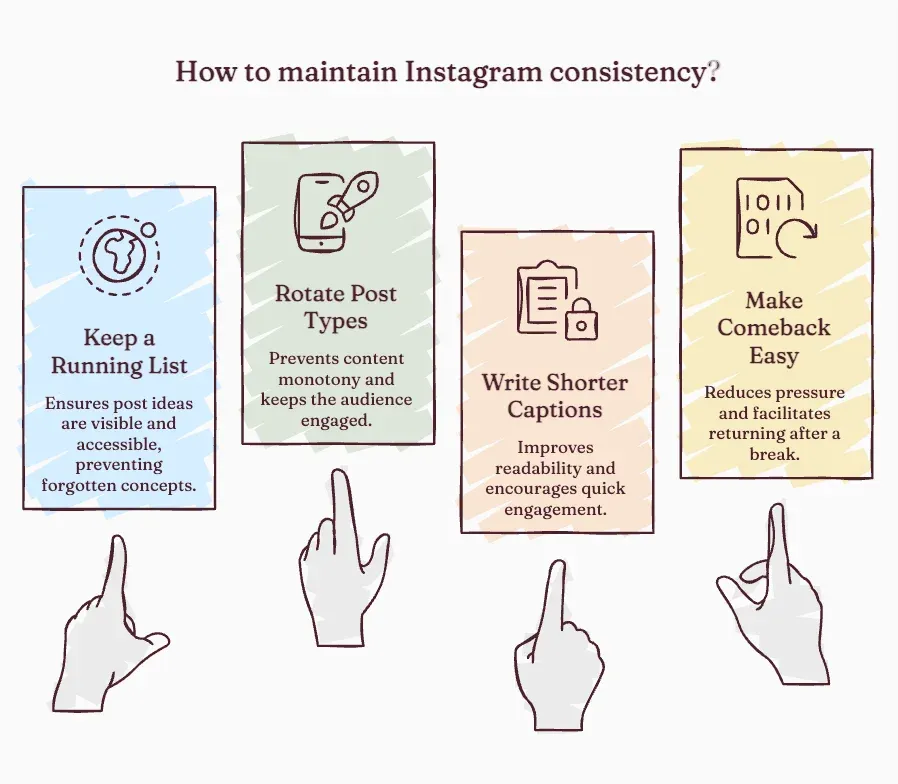
Here’s the system I’d put in place:
Not in your head. Not in a fresh note you’ll forget about. Somewhere visible - your phone’s notes app, a sticky note near your desk, a voice memo.
Every time something happens in your business that could be interesting - a customer reaction, a new product, an observation, a small tip - log it. When it’s time to post, you’re choosing from a list. Not generating from nothing.
You don’t need a different format every day. In fact, rotating a small set of familiar types makes things easier because you already know what the post looks like before you start.
Some formats that work for most small businesses:
That’s four formats. That’s a week of content without any original thinking about structure.
This is the one I push back on most consistently. Business owners often write long, careful captions because they feel like they need to justify posting. They don’t.
Short and specific beats long and careful. “This week’s custom order - can you spot the ranunculus? They’re my favourite right now.” That’s a caption. Done.
You will have weeks where you don’t post. That’s not failure - that’s running a business. What matters is that coming back doesn’t feel like a big deal.
No big “I’ve been absent” post. No apology. Just: “Here’s what’s happening today.” Pick up where you left off. Every account that’s been going for more than a year has gaps. Your audience doesn’t track them as closely as you do.
I want to be honest about the limits of what I’ve described above. Even with a running list and a rotation of formats, there are still weeks where:
This is the point where most people stop again. Not because they don’t care - but because the system still requires energy they don’t have.
The hardest week to post isn't when you're busy. It's when you're busy *and* you can't think of anything to say.
This is the exact problem Story Inventory is built around.
Instead of figuring out what to post every time, it generates weekly post ideas for your type of business, suggests captions that sound like you, and helps you maintain a content presence without the mental overhead of doing it all from scratch.
It’s not about posting more. It’s about making posting feel light enough that you actually keep going - even in a busy week.
Consistent at a lower frequency, every time.
I can’t stress this enough. Three posts a week for three months will do far more for your account than twenty posts in one week followed by silence. The algorithm favours active accounts, and your audience builds recognition through repetition - not volume. Instagram’s own ranking documentation confirms this: the algorithm prioritises accounts that earn consistent early engagement - saves, comments, and shares in the first hour of posting - not accounts that show up once a month with a surge of posts.
Less than you think, especially early on.
Hootsuite’s analysis of 1M+ posts does show real patterns - engagement tends to peak in the late afternoon on weekdays - but the differences are modest, and they’re based on your specific audience, not a universal rule. It’s worth experimenting once you have a regular posting rhythm, but I wouldn’t let timing become a reason to delay. Post when it’s convenient for you. Getting it out consistently is more important than hitting the “perfect” window.
If it works for you, yes - batching can remove a lot of daily friction.
But I’ve seen people spend hours batching content and then feel like they’ve done the work, when really the hard part is still showing up every day to actually post it. If batching helps you, great. If it becomes another procrastination tool, skip it.
No.
Just post something. Your audience has their own life - they’re not tracking your posting calendar. A long absence feels enormous to you and almost invisible to most of your followers. Return without fanfare: “Here’s what’s been happening” is plenty. The worst thing you can do is keep waiting for the “right” moment to come back.
This one is hard, and I want to be honest: early-stage Instagram growth is slow and the feedback loop is weak.
What helps is shifting the goal away from metrics and toward habit. Tell yourself you’re building a posting habit, not chasing follower counts. Results come with consistency over months - but the habit is what you can control right now.
Don’t aim to fix your Instagram. Just aim to make it lighter.
A smaller, simpler system that you actually follow is worth a hundred elaborate content strategies that stay in a draft tab.
Start with a list of ideas. Pick two post types. Post something this week - even if it’s small.
The goal isn’t perfection. It’s showing up regularly, in a way that fits around your business - not on top of it.
And if you want something that removes most of the thinking entirely, Story Inventory is built for exactly that.
Start with the Sustainable Posting Planner to choose a rhythm, then use the Social Media Time Audit to find which part of the work is costing you most.
A calmer way
to run social media
Just a few
quick clicks
Calls. Orders. Problems to solve.
You do not have hours for content.
And, honestly, you do not need them.